Introduction
A full sleeve tattoo is one of the most ambitious and rewarding tattoo projects a person can choose. Unlike a small tattoo that can be completed in a single appointment, a sleeve tattoo is a large-scale artwork that covers most or all of the arm, usually from the shoulder to the wrist. Because of its size and complexity, creating a sleeve tattoo requires careful planning, multiple appointments, and proper healing between sessions.
One of the most common questions clients ask before starting their tattoo journey is:
“How many sessions does a full sleeve tattoo need?”
Whether you’re considering a black and grey sleeve, a Japanese-inspired design, a realism masterpiece, or a custom storytelling sleeve, understanding the timeline helps you plan your budget, schedule, and expectations.
As professional tattoo artists, we’ve worked with clients across different styles, skin types, and design preferences. While every sleeve project is unique, there are clear factors that determine how many sessions you’ll need and how long the entire process will take.
Quick Answer
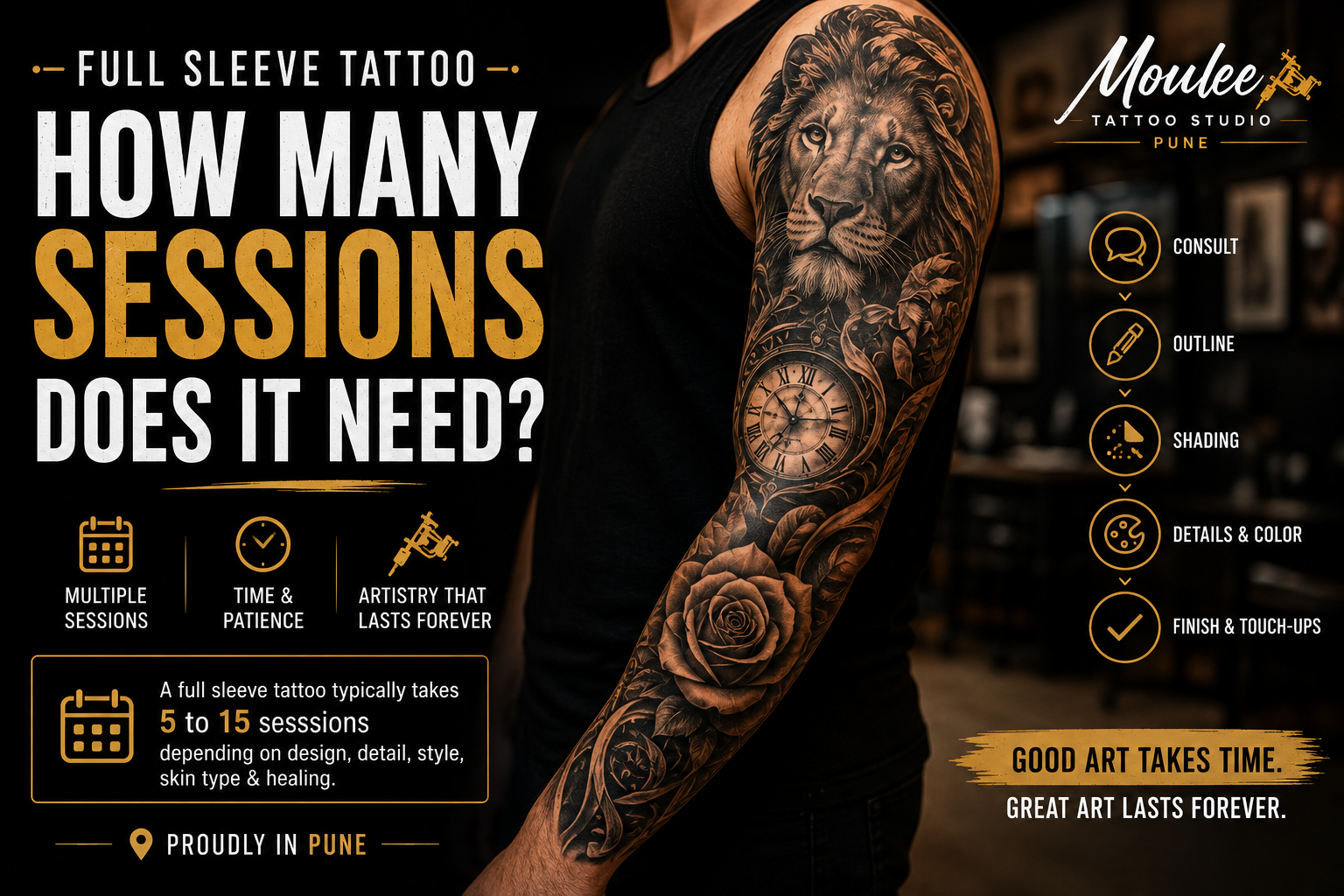
A full sleeve tattoo typically takes between 5 and 15 sessions depending on tattoo style, size, detail level, skin type, pain tolerance, healing speed, and artist availability.
A simple blackwork sleeve may be completed in approximately 5–7 sessions, while a highly detailed color realism sleeve can require 12–15 or more sessions spread over several months.
Most professional tattoo artists recommend dividing the work into multiple sessions to ensure proper healing, better ink retention, and higher-quality results.
What Is a Full Sleeve Tattoo?
A full sleeve tattoo covers nearly the entire arm, starting from the shoulder and extending down to the wrist. Unlike a collection of disconnected tattoos, a true sleeve is usually designed as one cohesive piece of artwork where all elements flow together.
Popular sleeve tattoo themes include:
- Japanese mythology
- Religious artwork
- Nature-inspired designs
- Geometric patterns
- Blackwork concepts
- Realistic portraits
- Family tribute tattoos
- Spiritual symbolism
- Fantasy and mythology
- Tribal artwork
Because a sleeve covers a large area of skin, it requires significantly more time than smaller tattoo projects.
Why Sleeve Tattoos Require Multiple Sessions
Many first-time clients wonder why a professional tattoo artist cannot complete a sleeve tattoo in a single sitting.
The answer is simple: quality.
A full sleeve involves:
- Extensive line work
- Detailed shading
- Color packing
- Background elements
- Fine detailing
- Healing time
Tattooing for excessively long periods can increase skin trauma, swelling, and discomfort. Breaking the project into multiple sessions allows the skin to heal properly and enables the artist to maintain consistent quality throughout the design.
Factors That Affect the Number of Sessions
Tattoo Design Complexity
The complexity of your design is one of the biggest factors affecting the number of full sleeve tattoo sessions.
Minimalist Sleeve
Minimalist sleeves focus on simplicity.
Characteristics:
- Fine lines
- Minimal shading
- Open skin areas
- Less ink saturation
Because there is less detail and less skin coverage, these sleeves are typically completed faster.
Estimated Sessions:
5–7 Sessions
Traditional Sleeve
Traditional tattoos use bold outlines and solid color blocks.
Features include:
- Thick line work
- Limited color palette
- Strong contrast
- Classic imagery
These tattoos are generally easier to execute than realism designs.
Estimated Sessions:
6–9 Sessions
Realism Sleeve
Realism tattoos require extraordinary precision.
Common realism elements include:
- Portraits
- Animals
- Clocks
- Roses
- Landscapes
Every detail must appear lifelike. Small mistakes become noticeable immediately.
Estimated Sessions:
10–15 Sessions
Japanese Sleeve
Japanese tattoos remain one of the most popular sleeve styles worldwide.
Common elements include:
- Dragons
- Koi fish
- Samurai
- Tigers
- Cherry blossoms
- Waves
These designs often include large background sections that require multiple appointments.
Estimated Sessions:
8–12 Sessions
Blackwork Sleeve
Blackwork tattoos rely heavily on solid black ink.
Although some people assume blackwork is quicker, large areas of saturated black can take significant time.
Estimated Sessions:
6–10 Sessions
Tattoo Size and Coverage
Not every sleeve covers the same amount of skin.
Half Sleeve
Coverage:
Shoulder to elbow or elbow to wrist.
Three-Quarter Sleeve
Coverage:
Most of the arm but not full wrist-to-shoulder coverage.
Full Sleeve
Coverage:
Entire arm from shoulder to wrist.
Naturally, larger coverage requires more sessions.
A heavily packed sleeve from shoulder to wrist may require nearly double the time of a simpler half sleeve design.
Color vs Black & Grey Tattoos
One of the biggest influences on session count is whether your tattoo uses color.
Why Color Takes Longer
Color tattooing requires:
- Multiple layers
- Color blending
- Saturation work
- Additional touch-ups
For example:
A black and grey realism sleeve may take 8–10 sessions.
The same design in full color may require 12–15 sessions.
Color pigments often require more attention to achieve smooth, vibrant results.
Skin Type and Healing Ability
Every person’s skin responds differently to tattooing.
Factors include:
- Skin sensitivity
- Hydration levels
- Oil production
- Immune response
- Lifestyle habits
Some clients heal remarkably fast.
Others may experience:
- Excessive peeling
- Longer recovery periods
- Minor irritation
Slower healing means longer gaps between appointments.
Pain Tolerance
Pain tolerance significantly impacts session length.
Some clients comfortably sit for:
- 6 hours
- 7 hours
- 8 hours
Others prefer shorter sessions of:
- 3 hours
- 4 hours
Shorter sessions usually increase the total number of appointments required.
Sensitive sleeve areas include:
- Inner bicep
- Elbow ditch
- Wrist
- Armpit region
Artist Working Style
Different tattoo artists work at different speeds.
Fast-Paced Artists
Advantages:
- Fewer sessions
- Faster completion
Potential drawback:
- Less time spent refining details
Detail-Focused Artists
Advantages:
- Superior precision
- Better realism
- Cleaner transitions
Potential drawback:
- More sessions
Most experienced professional tattoo artists prioritize quality over speed.
Average Session Breakdown Table
| Tattoo Style | Estimated Sessions | Average Hours Per Session | Total Tattooing Time |
|---|---|---|---|
| Minimalist Sleeve | 5–7 | 4–5 Hours | 20–35 Hours |
| Traditional Sleeve | 6–9 | 5–6 Hours | 30–54 Hours |
| Black & Grey Realism | 8–12 | 5–7 Hours | 40–84 Hours |
| Color Realism | 10–15 | 6–8 Hours | 60–120 Hours |
| Japanese Sleeve | 8–12 | 5–7 Hours | 40–84 Hours |
| Blackwork Sleeve | 6–10 | 5–7 Hours | 30–70 Hours |
Real-World Sleeve Tattoo Examples
Example 1: Black & Grey Lion Sleeve
A client in Pune wanted:
- Lion portrait
- Clock
- Rose
- Family quote
Project Breakdown:
Consultation: 1 Session
Outline: 1 Session
Lion Shading: 2 Sessions
Clock Detail: 2 Sessions
Background Work: 2 Sessions
Touch-Ups: 1 Session
Total:
9 Sessions
Example 2: Japanese Dragon Sleeve
Design Included:
- Dragon
- Waves
- Cherry blossoms
- Background shading
Because of the extensive black shading and large-scale composition, the project required:
8 Sessions
Example 3: Color Realism Sleeve
Design Included:
- Portrait
- Tiger
- Galaxy background
- Roses
This project required:
14 Sessions
Spread over nearly 10 months.
Typical Full Sleeve Tattoo Timeline
Session 1 – Consultation and Planning
This stage includes:
- Design discussion
- Reference images
- Placement planning
- Measurements
- Budget estimation
A strong consultation often saves time later.
Session 2 – Outline Work
The outline creates the foundation of the sleeve.
The artist establishes:
- Main shapes
- Flow
- Placement
- Composition
Sessions 3–5 – Major Shading
The sleeve begins developing depth.
This stage often includes:
- Shadows
- Texture
- Contrast
- Background foundations
Sessions 6–10 – Details and Color
Artists refine:
- Highlights
- Fine textures
- Facial features
- Color transitions
For realism sleeves, this phase may continue across multiple appointments.
Final Session – Touch-Ups
The last appointment focuses on:
- Healing corrections
- Contrast enhancement
- Final adjustments
This stage ensures the sleeve looks complete and polished.
How Long Should You Wait Between Tattoo Sessions?
Healing is one of the most overlooked aspects of a sleeve tattoo project.
Most professional tattoo artists recommend waiting:
2–4 weeks between sessions
For larger sections:
4–6 weeks may be ideal
Why Waiting Matters
Your skin needs time to:
- Repair damaged tissue
- Settle inflammation
- Retain ink properly
- Restore its protective barrier
Tattooing over skin that hasn’t healed can affect the final result.
Common Reasons Full Sleeve Tattoos Take Longer
Design Changes
Many clients add new ideas midway through the project.
Examples include:
- Extra portraits
- Additional symbols
- More background work
These additions naturally increase session count.
Missed Appointments
Rescheduling can extend completion timelines significantly.
A project expected to take six months may stretch to a year.
Healing Problems
Poor aftercare may cause:
- Excessive scabbing
- Ink loss
- Irritation
Additional touch-ups may become necessary.
Large Color Sections
Color saturation takes time.
Large red, blue, yellow, or green sections often require multiple passes.
Realism Detailing
Portrait tattoos frequently require extra refinement to achieve lifelike results.
How Much Does a Full Sleeve Tattoo Cost?
Full Sleeve Tattoo Cost in India
| Artist Level | Estimated Price |
|---|---|
| Beginner | ₹20,000 – ₹50,000 |
| Intermediate | ₹50,000 – ₹1,20,000 |
| Experienced Professional | ₹1,20,000 – ₹3,00,000+ |
Full Sleeve Tattoo Cost in Pune
| Tattoo Style | Estimated Cost |
|---|---|
| Minimalist Sleeve | ₹30,000 – ₹70,000 |
| Traditional Sleeve | ₹50,000 – ₹1,00,000 |
| Blackwork Sleeve | ₹60,000 – ₹1,20,000 |
| Japanese Sleeve | ₹80,000 – ₹2,00,000 |
| Black & Grey Realism | ₹1,00,000 – ₹2,50,000 |
| Color Realism | ₹1,50,000 – ₹3,50,000+ |
Full Sleeve Tattoo Healing Process
Week 1
The tattoo may feel:
- Warm
- Sensitive
- Slightly swollen
This stage focuses on cleanliness and protection.
Week 2
Typical symptoms include:
- Peeling
- Flaking
- Mild itching
Avoid scratching the tattoo.
Week 3–4
The surface appears healed.
However, deeper layers continue recovering.
Long-Term Care
Maintain tattoo quality by:
- Using sunscreen
- Staying hydrated
- Moisturizing regularly
Tips to Reduce the Number of Tattoo Sessions
Stay Hydrated
Healthy skin accepts ink better and recovers more efficiently.
Follow Aftercare Instructions
Good aftercare minimizes complications and touch-ups.
Avoid Sun Exposure
Sun damage can interfere with healing and color retention.
Finalize the Design Early
Clear planning prevents unnecessary revisions.
Get Enough Sleep
Proper rest supports healing and helps you tolerate longer sessions.
Frequently Asked Questions
How many sessions does a full sleeve tattoo need?
Most full sleeve tattoos require between 5 and 15 sessions depending on complexity, style, color usage, and healing speed.
Can a sleeve tattoo be done in one sitting?
Technically yes, but it is rarely recommended. Multiple sessions produce better results and allow proper healing.
How long does a full sleeve tattoo take to finish?
Most projects take between 3 and 12 months from consultation to completion.
Does a color sleeve require more sessions?
Yes. Color tattoos typically require additional sessions for layering and saturation.
How painful is a full sleeve tattoo?
Pain varies by person and body location. The elbow, wrist, and inner arm are generally more sensitive.
How much does a full sleeve tattoo cost in Pune?
A professionally designed sleeve tattoo in Pune can range from ₹30,000 to ₹3,50,000 or more.
How long should I wait between sessions?
Most artists recommend waiting 2–4 weeks between appointments.
What happens if I miss a session?
Missing a session won’t ruin the tattoo, but it may delay project completion.
Can I go to the gym during a sleeve tattoo project?
Avoid intense workouts for several days after each session to reduce irritation and infection risk.
Do sleeve tattoos require touch-ups?
Yes. Most sleeve tattoos benefit from occasional touch-ups over time.
Conclusion
So, how many sessions does a full sleeve tattoo need?
For most people, the answer is between 5 and 15 sessions, with some highly detailed projects requiring even more. The total number depends on tattoo style, design complexity, color usage, healing speed, pain tolerance, and the working approach of the tattoo artist.
A sleeve tattoo is more than a tattoo appointment—it’s a long-term artistic collaboration. Taking the time to heal properly and working with an experienced professional tattoo artist ensures a result that looks incredible for years to come.
Whether you’re planning a Japanese sleeve, blackwork masterpiece, realism project, or a completely custom concept, understanding the process helps you prepare for the journey ahead.
About Moulee Tattoo Studio
Looking for a trusted tattoo studio in Pune?
Moulee Tattoo Studio specializes in custom tattoo designs created by experienced professional tattoo artists who prioritize creativity, safety, precision, and hygiene.
Why choose Moulee Tattoo Studio?
- Professional tattoo artists with years of experience
- Custom-designed sleeve tattoo concepts
- International hygiene and sterilization standards
- Detailed consultation process
- Premium tattoo equipment and inks
- Expertise in realism, blackwork, Japanese, traditional, and custom styles
- Transparent pricing and project planning
Every sleeve tattoo begins with a personalized consultation where the design, timeline, budget, and estimated session count are carefully discussed. This ensures that every client receives a tattoo that matches their vision while maintaining the highest quality standards.
Ready to Start Your Sleeve Tattoo Journey?
Book a consultation with Moulee Tattoo Studio, Pune, and get expert guidance on your sleeve tattoo project. Whether you already have a design in mind or need help creating one from scratch, our team can help bring your vision to life.
Contact Moulee Tattoo Studio today and take the first step toward creating a full sleeve tattoo you’ll be proud to wear for life.
Leave a Reply